

AN INTERGALACTIC TRANSPORT OVERSHOOTS THEIR DESTINATION BY 50 YEARS.

AN INTERGALACTIC TRANSPORT OVERSHOOTS THEIR DESTINATION BY 50 YEARS.
All You Need to Know About Gay or Lesbian Cruises / ZACHARY LAKS

Recognizing the surging demand, nearly every cruise line, from luxury to midrange to mass market, works to attract gay and lesbian travelers. LGBTA cocktail parties or meetups are a popular activity onboard various ships. Some cruise lines even cater to the community on land through various partnerships. (For example, Celebrity Cruises sponsors the Miami Beach Gay Pride festival, the first cruise line to ever partner with this celebration of the community.)
Passengers will find gay and lesbian travelers on just about any cruise, but some companies offer specialized sailings catering specifically to gay cruisers. All-gay charter companies, such as Atlantis Events (focused on gay men) and Olivia (exclusively for lesbians), charter entire cruise ships — from large, mainstream ships and smaller luxury ships to riverboats — and customize the whole trip.
The charters work closely with the cruise line to develop itineraries, and they always bring aboard their own group of entertainers, musical guests and speakers. Major cruise lines that frequently host LGBTQ charter cruises include Celebrity, Holland America, Royal Caribbean, Uniworld, Azamara and Virgin Voyages.
Here, we introduce you to the main charter companies catering to LGBTQ cruisers, and provide a preview of upcoming gay and lesbian charter cruises. Cruises can expect many postponed trips to finally set sail, a few newly-charted cruises that are sure to sell out fast, and new travel groups catering to the LGBTQ community.
Gay and lesbian charter companies conduct extensive research before committing to a foreign destination. There have been well-publicized incidents of all-gay charters facing opposition and scattered protests at ports in such countries as Grand Cayman, Jamaica and Turkey, so the gay charter companies generally steer clear of controversy and head to the “greatest hits” port stops, mostly in the Caribbean and Europe. Gay travelers should be aware that, in some ports, they might be faced with different levels of social tolerance.
This information, with specific dates, offers a snapshot of some of the adventures, but it’s not meant to serve as a comprehensive calendar. Refer to each company’s website for any updates or additions. Be aware that some gay and lesbian cruises sell out very quickly.
Winter Wonderland & Christmas Market Riverboat Cruise
The charm of Christmas perfected in true historic European style,
Winter Wonderland & Christmas Market Riverboat Cruise is Olivia’s third Christmas market tour.
This year, board Avalon’s Imagery II
along with over 120 women for a holiday-spirited journey from Frankfurt to Prague. The journey includes stops in Würzburg to see the largest ceiling fresco ever painted, a guided tour of medieval Bamberg, a UNESCO World Heritage Site and the delicious hot mulled wine of Nuremberg. Fares start at $4,399 for a porthole cabin, based on double occupancy.
Dates: Nov. 29 – Dec. 7, 2021
Costa Rica and Panama Canal Luxury Cruise
Head to the rainforest in a sailing yacht with this
Costa Rica and Panama Canal Luxury cruise
aboard Windstar’s 148-passenger
. Explore mangrove swamps, jungle forests and beautiful beaches in search of the region’s diverse flora and fauna. A private beach barbecue and Panama Canal transit will be highlights. Fares start at $5,459 for an outside cabin with a porthole, based on double occupancy.
Dates: Jan. 15 – 22, 2022
Why You Should Think Twice Before You Talk About It.
| BY CURVE STAFF

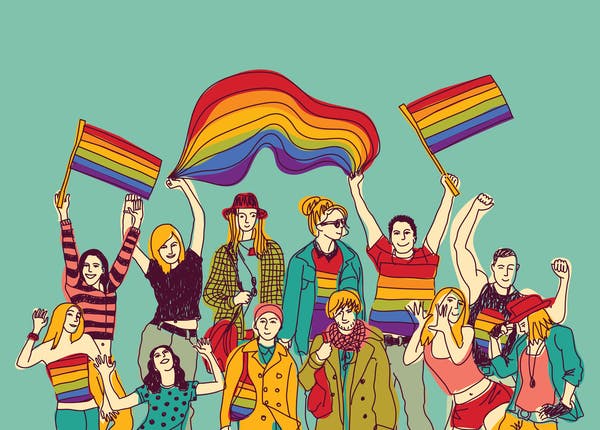
Not everyone’s experience of sexuality or gender is the same.
What does the phrase “LGBT community” mean to you? Chances are if you don’t identify as lesbian, gay, bisexual or trans yourself, you might think about what you’ve seen on TV – so Queer as Folk, Orange is the New Black, or The L Word , to name a few TV hits. It might also bring to mind images of brightly coloured rainbow flags or Pride parades.
But just stop for a minute and think about how often you’ve heard someone talk about “the heterosexual community”? Rarely I imagine – but the term “LGBT community”, or sometimes “gay community”, is frequently used by pretty much everyone.
This might not sound like a big deal – after all it’s just a phrase used to identify a large group of people, right? But herein lies the problem, because after carrying out my latest research, which involved over 600 LGBT participants from across the UK, I’m not sure that community is a very suitable word for such a diverse group of people.
And as I explain in my new book, Exploring LGBT spaces and communities, the term “LGBT community” can be understood in many different ways, and can mean many different things to many different people.
In my research, people often said they experienced the “community” part of the phrase as an actual physical space. This could be a particular geographical area such as Brighton or San Francisco, or could relate to places frequented by LGBT people – such as bars and clubs – often referred to as “the scene”.
People I spoke to also reported experiencing this community aspect as part of a virtual space – such as online, or even in an imagined sense – in that LGBT people were thought to share “something”.
People revealed how they often had fears or negative expectations of wider society. And that this is in part why they invest in the idea of an LGBT community – as somewhere where they could feel safe and understood.
But the term does not capture differences and complexities of experience. It can also wrongly suggest some form of shared experience, which for some people can be frustrating because it seems to ignore their experiences of inequality or discrimination within – or exclusion from – so-called “LGBT community”.
Then there is also the issue of the acronym “LGBT” itself, as it excludes a lot of people – such as those who identify as queer or intersex. And it was clear in my research that some people feel less welcomed within this acronym. Even those who do feature within these four letters – notably bisexual and trans people – can often feel marginalised by lesbian and gay people, and like that they don’t really belong to such a “community”.
People also spoke about their quest to find this “community” – with many trying and failing to discover such a thing. The idea of an LGBT community suggests that people who identify in this way should feel part of something. If they don’t it can compound negative experiences.
Many participants in my research also talked about experiencing discrimination from other LGBT people relating to their age, body, disability, ethnicity, faith, HIV status, or perceived social class. So although the phrase implies that LGBT people somehow automatically belong to a ready made community – this is simply not the case.
It is clear then that community belonging is not a given just because people share a gender or sexual identity. And this is why the notion of “LGBT community” is problematic. As someone I interviewed argued:
The idea doesn’t exist, it’s a kind of big myth – a bit like saying there’s a brown-eyed community or a blonde community.
In this way, then, the use of the term “LGBT community” could alienate some people and even risks deterring LGBT (and other) people from engaging with services aimed specifically at them. As another participant said:
I find anyone who uses this language dubious and with doubtful intention.
This is not to say that we should abandon the phrase altogether, but often using “LGBT people” would be more accurate – and would not risk alienation felt by an already (at times) marginalised group of people.
Eleanor Formby, Senior Research Fellow in Sociology and Education, Sheffield Hallam University
This article is republished from The Conversation under a Creative Commons license. Read the original article.
8 tales of dominant women, that see their subs as individual secret gardens. As their domme they expect from them nothing less than their bodies and souls. Expected to do whatever their dommes want so the pleasures of the domme are also the sub’s pleasure
PLEASE CLICK HERE TO PURCHASE THIS BOOK.

Bound to Lose
Jessica has found herself to be very unlucky in love. Bi-Sexual though she is, she just can’t win with either sex
Before the Mistress and the Stepmother there was Olivia’s Humiliation
A prequel to the bestselling ‘The Tale of the Mistress and the Stepmother’. A look at Olivia as she entered the BDSM lifestyle. More
Controlled
Abbey is obsessed with Jessica, a young who works with her, and would like nothing better than to make Jessica her a love slave
Duchess of Domination
Stacey decides to skinny dip in the deserted hotel pool early one the morning. That idea gets squashed when Ciara arrives to crash her party
Love Hurts
Linda is a successful business owner. She also is a mother of her eighteen year old daughter Jenn and she is a lesbian.
Pleasure Bound
Husband out of town, Joanna gets to indulge in her secret fetish with Mistress Carol with a surprise visit from Carol’s friend Erma.
The Care and Feeding of Pets
Sienna has a dominant relationship with Naomi. Naomi is Sienna’s pet and Sienna is careful to nurture the symbiotic relationship.
The Tale of the Mistress and the Step-Mother
The Tale of the Mistress & the Step-Mother is a story for fans of older women dominating younger women. A story filled with the erotica pleasure and penetrating emotions. At times it is difficult to determine the Dom or the Sub.
Connect with Candice Christian
I really appreciate you reading my book! Please, if you have time, review my book.
Here are my social media coordinates:
Join me on Facebook Group:
https://www.facebook.com/pg/Fans-of-Candice-Christian-2167845756865295/about/?ref=page_interna
Favorite my author page:
https://www.smashwords.com/books/view/914732
Subscribe to my blogs:
https://eroticlesbianromance.blog/
Visit my website for free stuff and news about releases:
WATCH FOR THIS MUCH ANTICIPATED COLLECTION COMING IN NOVEMBER

EIGHT OF THE MOST PROVOCATIVE TALES OF LESBIAN DOMINATION! SO HOT YOU’RE SURE TO READ IT COVER TO COVER SEVERAL TIMES.
That Are Actually True – and the Surprising Reasons Why
s

Written by:Anna Pulley , AlterNet and Anna Pulley December 21, 2015
Stereotyping is a necessary evil. Stereotyping simplifies complex information so our brains can easily understand it, reducing the amount of processing we go through when seeing or meeting new people That said, it also causes us to generalize. If we see one hipster drinking PBR and wearing an “Everyone loves Grandpa!” T-shirt, our brain is like, #YesAllHipsters.
When it comes to lesbians, I was curious if the stereotypes had a basis in reality, partly because I am a former gym teacher who drives a truck and loves cats and has a wardrobe that’s 90 percent flannel. I’ve probed the data to see if the old lines about U-Hauling, lesbian bed death and others had any statistical sway. The results were surprising.

1. U-Hauling.
The most common lesbian joke is often attributed to comedian Lea Delaria, who once remarked: “What does a lesbian bring on a second date? A U-Haul.” This plays into the notion that queer women tend to move in together at lightning-fast speeds. While there are no significant statistics comparing the cohabitation speeds of queer vs. straight women, there is some science that pinpoints why a lesbian couple might move in together sooner than a hetero couple. Some of these reasons have to do with societal norms, financial benefits, and hormones.
“U-hauling happens for two reasons,” explains clinical psychologist Lauren Costine at AfterEllen. “Biologically our brains are wired for relationships and connection. We emit much more oxytocin than men. Oxytocin is a hormone women emit when they’re falling in love, having sex, or breastfeeding. It’s biological encouragement to attach. It feels so good that for some women, in this case, lesbians, they can’t get enough. Since there are two women, there’s twice as much oxytocin floating around.”And we all know what happens when you leave oxytocin floating around: trips to Bed, Bath and Beyond.
2. Processing.
Another oft-recited stereotype is that lesbians are known to process everything to death. Q: How many lesbians does it take to screw in a lightbulb? A: I don’t know. Should we use LEDs? What wattage? Are these recyclable? Maybe this is a sign we should be lowering our carbon footprint. Let’s make a pro and con list of solar panel options and revisit this next year.
Processing is the tendency to overanalyze and over discuss every aspect that can be analyzed or discussed. When it comes to relationships, it turns out this works in lesbians’ favor. According to a 12-year study by John Gottman of the University of Washington and Robert Levenson of the UC Berkeley, gay and lesbian couples are excellent communicators who use fewer “controlling, hostile emotional tactics” when fighting, such as belligerence, domineering, and fear. “The difference on these ‘control’ related emotions suggests that fairness and power-sharing between the partners is more important and more common in gay and lesbian relationships than in straight ones,” Gottman explained.
3. Lesbian bed death.
The dreaded “bed death,” or the notion that lesbians in committed relationships stop having sex with each other, is a touchy topic. According to Karen Blair, a professor at St. Francis Xavier University and a member of the Society for the Scientific Study of Sex, only 15 percent of lesbian couples engage in sex more than twice a week, compared to 50 percent or more of other comparison groups (straight couples and gay men).
But! While it’s true that lesbians have less frequent sex than their straight counterparts, lesbian sex lasts far longer:
“Women in same-sex relationships reported significantly longer durations of sexual encounters than individuals in all three comparison groups, with their median duration falling within the 30 to 45-minute range, compared to the 15 to 30-minute range most commonly reported by participants in other types of relationships.” Also, almost 10 percent of lesbians get it on for more than two hours, compared to 1.9 percent of straight couples.
“Furthermore,” Blair explains, “very few women in same-sex relationships reported very brief sexual encounters, possibly providing a hint as to why their sexual frequency numbers tend to be lower than the other three groups.”
4. Lesbians know how to please their partners.
No doubt partially due to lesbians’ excellent communication skills and lengthy lap-nap sessions, lesbians have more orgasms than straight and bi women. A study published in the Journal of Sexual Medicine polled 1,497 men and 1,353 women who’d been sexually active within the past year. Participants were asked to state their gender, sexual orientation, and the percentage of time they orgasmed “with a familiar partner.”
Researchers found that heterosexual women reported orgasming just 61.6 percent of the time, and bisexual women followed close behind with 58 percent. Lesbians, however, reported coming 74.7 percent of the sexytime.
Way to bring your gAy game, wimmin.
5. The L Word: Lesbians love Leisha.
According to data culled from its four million users, online dating site OkCupid revealed in a survey that “The L Word” was not only the most common phrase used on lesbians’ profiles but it was also used so frequently it didn’t even fit on the graph relative to the amount of times lesbians used it. Analysts had to shrink it down to fit OkC’s template. Love it or hate it, if you like ladies, you probably watched the Showtime series that aired from 2004 to 2009. More than once.
Also unsurprising is the prevalence of Tegan and Sara and Ani DiFranco mentions, as well as the cult-fave TV show “Buffy the Vampire Slayer,” which featured one of the first lesbian kiss scenes on U.S. television.
6. Lesbians are kinkier and druggier.
According to OkCupid data again, the attributes lesbians used to describe themselves most often were artsy, adventurous, kinky, and almost half said they were “into drugs.”
Curiously, straight women were more “into sports” (so there goes that lesbian stereotype?), as well as optimistic and far more likely to identify as religious. In addition to drugs, lesbians and bisexuals tend to drink more alcohol than straight women. Though this rate has been declining in the past two decades, substance abuse is still a big issue when it comes to overall health (especially because queer women are less likely to have insurance and visit doctors regularly).
7. Lesbians reject cultural norms and dominant beauty standards.
Research has shown that lesbians tend to have better body images than straight women, possibly because they have a broader definition than the general public of what’s beautiful and sexy. (This also contributes to queer women having better sex, as the better one feels about one’s body, the more enjoyable sex is.) Some researchers posit that because dating a same-sex partner is already a move away from the mainstream, lesbians would also reject cultural messages about the “ideal” female body. Feminist values, which many lesbians ascribe to, also play into lesbians’ tendency to enjoy, celebrate and accept more body diversity than their straight counterparts.
Leigh is trapped in a sexless marriage and finds that going clothes shopping in the mornings helps take her mind off her problem until she is caught in a changing room doing something she shouldn’t by an attractive red head.
PLEASE CLICK HERE IF YOU WOULD LIKE TO PURCHASE THIS STORY
Twenty-something Leigh is married to a very inattentive husband and finds other past times to take her mind off her sexless marriage. Clothes shopping was her favorite pastime; that is until an attractive older red-haired woman walked into her changing room and caught Leigh doing something she shouldn’t have been doing.
The sexy redhead see an opportunity and tests the waters with the surprised married woman. She finds that Leigh is unable to tell her no, when she makes a lascivious advance on her. With that knowledge the woman, Morgan quickly removes the girl from the store and whisks her to her apartment.
The naïve Leigh may be inexperienced in lesbian romance, but Morgan realizes Leigh is a quick learner. The lusty red head puts the younger girl through her paces, exploring every nook and cranny on her prey. At the same time, Morgan exposes Leigh to some of the more debauched and wicked aspects of lesbian lovemaking.
Connect with Candice Christian
I really appreciate you reading my book! Please, if you have time, review my book.
Here are my social media coordinates:
Join me on Facebook Group:
https://www.facebook.com/pg/Fans-of-Candice-Christian-2167845756865295/about/?ref=page_interna
Favorite my author page:
https://www.smashwords.com/books/view/914732
Subscribe to my blog:
https://eroticlesbianromance.blog
Visit my website for free stuff and news about releases:
Exclusive: Here’s a First Look
BY ALEX COOPERNOVEMBER 05 2021 12:40 PM EDT


The docuseries Tampa Baes premieres November 5 on Prime Video. The show focuses on queer women in the Florida city.
The eight-episode series from 3 Ball Productions “follows a young group of lesbian friends in Tampa Bay, an ever-growing gay hotspot on the Florida shoreline,” according to a press release from when the show was announced.
The series stars Ali Myers, Nelly Ramirez, Shiva Pishdad, Jordan Whitley, Marissa Gialousis, Summer Mitchell, Cuppie Bragg, Brianna Murphy, Haley Grable, Melanie Posner, Olivia Mullins, and Mack McKenzie.
“This series is fun and celebratory. In a world where there’s a dearth of content centering dynamic lesbian women, Amazon Studios is excited to bring this vibrant look at these women’s lives and give the world a real entry point to undoubtedly know and love them,” Vernon Sanders, co-head of television at Amazon Studios, said previously in a release.
Tampa Baes’ out executive producer and showrunner, Melissa Bidwell said that she and her co-executive producer, Paul O’Malley, who is also out, are always on the lookout for unique groups of people willing to share their stories.
“When we heard about this group of friends in Tampa Bay, a true hidden gem for the LGBTQ+ community, we were blown away by how interesting each of the baes are,” Bidwell said in announcing the series.
“Whether it’s a coming out story from one of our ladies that will resonate with a closeted teen in Middle America, a cast member bravely and openly dealing with mental health issues, or a lesbian couple navigating being young and in love, all ages and demos will be able to watch this and relate. Well, maybe teens and up… we do have some racy stuff!” Bidwell said.
“It’s a jam-packed season,” Bidwell assured. “I’m excited for the audience to see pretty much everything! It’s definitely a wild ride.”
Viewers can catch the show on Prime Video starting today.
Sherry is a free-lance writer for the Windsor LGBTQ+ Performance Arts Festival group and has been assigned to cover story on their Underground Women’s Erotic Sports program. Her in-depth story leads her to going home with one of the female participants.
PLEASE CLICK HERE IF YOU WOULD LIKE TO PURCHASE THIS STORY

Sherry, a very straight female, with lesbian fantasies, covers an erotic women’s wrestling show between The Succubus and The Viper. The erotic performance is shocking yet arousing to Sherry as the Viper sexually humiliates the Succubus. As a result of interviewing the winner after the performance, Viper talks Sherry into going home with her after the performance.
Once at the Annie’s home, the Viper’s real name, Sherry and Annie get real cozy and learn about each other. Annie is a bi-sexual that leans heavily toward the lesbian lifestyle. This revelation allows Sherry to share her dream fantasy with Annie. Her fantasy is a wild threesome.
Try as she would, Sherry was never able to organize such a thing, due to finding willing participants. Even her lifelong friend Eileen balked at the idea. Annie tells her she has been looking in the wrong places and proceeds to give her a lesson in lesbian love, and the organization of an enjoyable threesome.
Sherry tells Annie she has heard of a place called the Ocean Peak Sanctuary that seems idea for a threesome. She has her heart set of engaging in a threesome at the Sanctuary away from prying eyes, since it’s a safe distance from her home. Annie gladly accepts the offer and implies finding the third party of the threesome will be her responsibility. The reservation are set, and anticipation is high, Sherry is as giddy as a school girl once they arrive.

 Romantic Lesbian Erotica